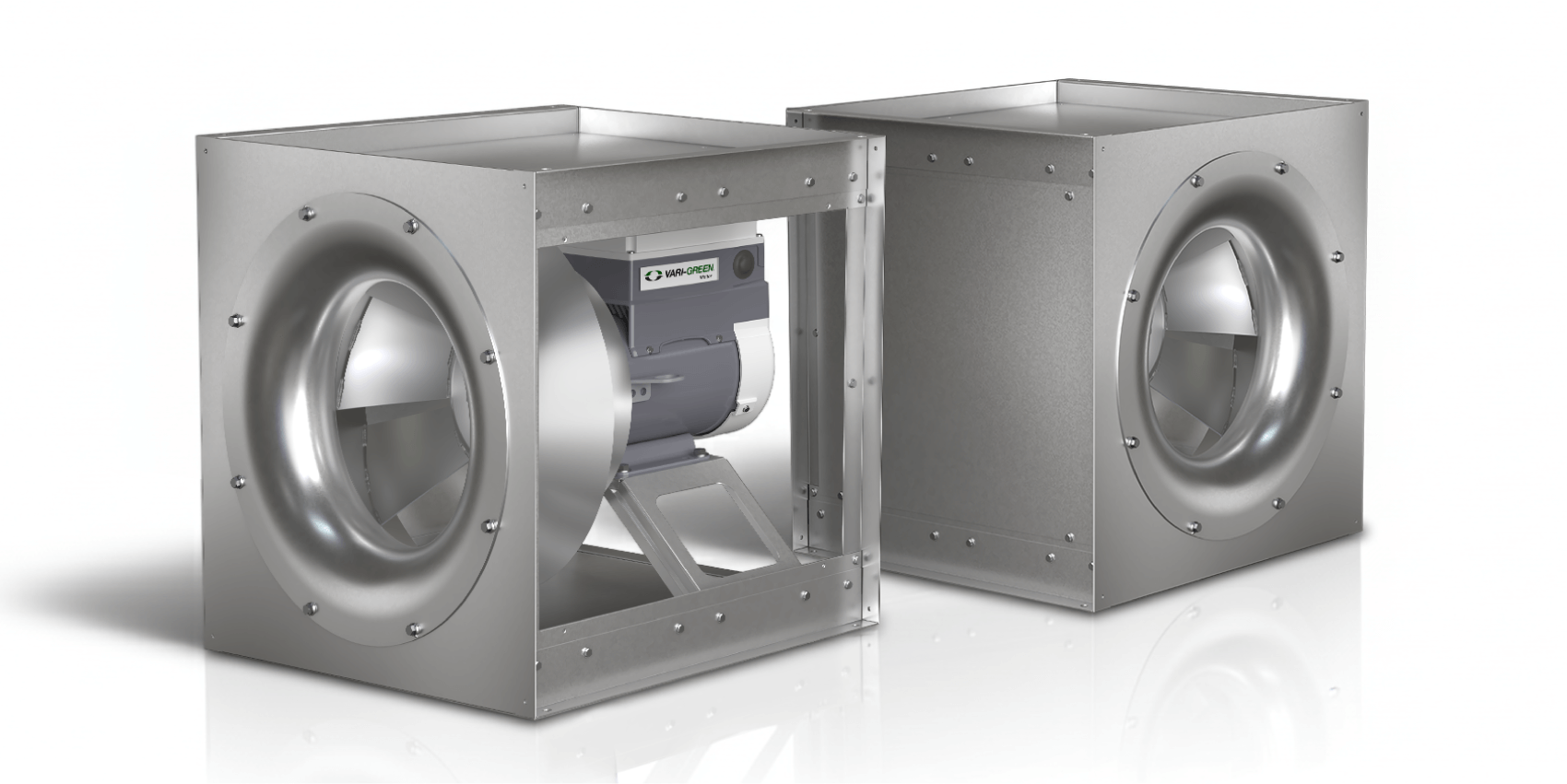
Applications that need to harness a lot of energy, such as a data center with the computing power necessary to train an AI system, need many inline transfer fans to keep rooms cool and balance air pressure. All these fans consume electricity, so making the decision to install energy-efficient inline fans saves significant money for the building owner. In this blog post, you’ll learn about an energy-saving and high-performance fan option: the direct drive mixed flow fan.
What Is a Mixed Flow Fan?
- A square inline fan is typically installed in a ducted system. The fan’s impeller is the rotating component that converts motor energy into air movement.
- The most common impeller type for an inline fan is the centrifugal wheel, where air travels into the impeller and exits at a 90-degree angle. The centrifugal inline fan is often used in applications where it needs to overcome high static pressures and/or high resistance due to long duct runs.
- In an inline fan using a mixed flow wheel, the air makes two 45-degree turns as it passes through the fan. The impeller swings the air outward, adding tangential momentum. This design allows the mixed flow fan to deliver higher airflow at moderate static pressures while being more compact than a centrifugal design.
- For inline fan applications at moderate static pressures, the mixed flow fan is usually the most efficient and quietest selection.
Efficiency, Size, and Installation Advantages
The greater efficiency of the mixed flow fan over a traditional centrifugal fan allows for a smaller motor, particularly at moderate airflow and moderate pressure. The downsized motor allows for lower full-load amps (FLA), which are the amperage the motor is expected to draw when operating at its rated load under specified conditions. The lower FLA means an electrician can use lighter-gauge wire, reducing the cost of the electrical hookup. Finally, the lower amount of energy consumed in operation means lower electricity bills for the building owner.
Mixed flow fans are on average 13% smaller than centrifugal fans and 4 decibels quieter. They have features such as integral isolator rails as part of the fan housing, so the fans can be hung with ease upon arrival at the jobsite. Factory wiring outside the fan housing means contractors don’t have to go inside the fan housing for electrical access.
Mixed flow fans are available in both commercial and industrial housings. At moderate airflow, a typical mixed flow inline fan only has a first cost up to 5% higher than a centrifugal inline fan. The annual operating savings more than make up for that, as the next section demonstrates.
Performance and Energy Savings in Real Applications
An airflow of 3500 cfm and a static pressure of 0.5 in. wg are common performance points for inline fans, particularly exhaust fans around electrical rooms in data centers. Table 1 compares the power consumption of a mixed flow inline fan at this duty point to that of a centrifugal inline fan, with each fan operating 8,000 hours a year. All electrical data is from Greenheck’s CAPS® selection software.
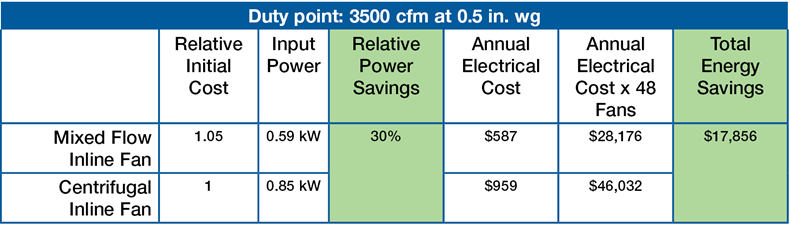
Table 1
The mixed flow fan costs up to 5% more initially but uses 30% less input power. At 8,000 operating hours a year, scaled up to a 48-fan package, going with mixed flow saves an estimated ~$18,000 in operating costs every single year.
The following diagrams demonstrate why mixed flow fans reduce motor size and electrical requirements compared to centrifugal designs at the same duty point.
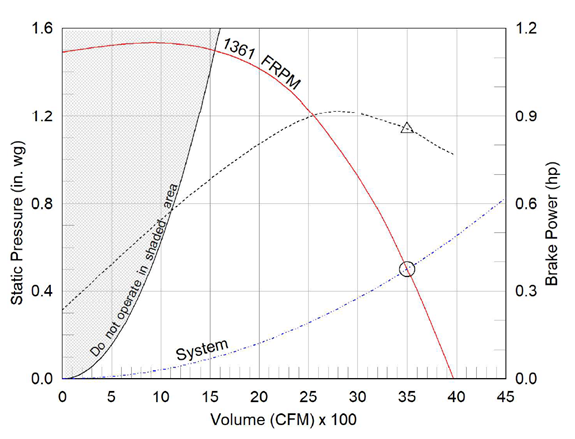
Diagram 1
- Diagram 1 shows a direct drive centrifugal inline fan with a 2 hp motor operating at 3500 cfm at 0.5 in. wg. This requires 1361 FRPM (fan RPM) and just under 0.9 bhp.
- With an 1800 rpm 1 hp motor, only ¾ hp is available, because of the slow speed the fan is running at. Therefore, it is necessary to upsize to 2 hp even though only 0.9 hp is needed.
- This raises the full-load amps on the circuit, the complexity for the electrician, and the overall installation and operating expenses.
Diagram 2 shows a direct drive mixed flow inline fan operating at the same performance point.
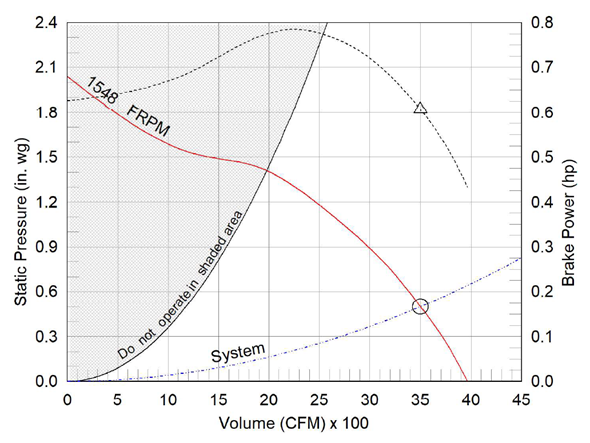
Diagram 2
- Switching to a smaller mixed flow fan and running it slightly faster (1548 FRPM as opposed to 1361 FRPM) allows us to use only 0.6 bhp at the same performance point.
- This, in turn, allows for a smaller 1 hp motor and a full-load amperage of half what the centrifugal fan consumes, resulting in significant electrical savings when scaled up to a system of dozens of fans.
- The mixed flow fan will be two decibels (dB) quieter in this scenario.
A Smarter Choice for HVAC Systems
The mixed flow fan is a sensible choice as the default fan for high-efficiency and sound-sensitive applications. It can be used to comply with efficiency requirements and has a high level of field mounting adjustability. Mixed flow fans typically allow for downsizing 2–3 sizes over legacy centrifugal fans. By reducing motor size, electrical demand, and sound output while maintaining performance, mixed flow fans provide a practical path to long-term energy and cost savings in modern HVAC systems.
To discuss applying mixed flow fans to your next project, contact your nearest Greenheck representative.
Data Centers Fan Energy Index Fans