

Today’s contractors and facility managers face the realities of a labor shortage and widening skill gap among their staff. They often have fewer people than they need to service the rooftop HVAC equipment that is critical to the operation of commercial kitchens, restaurants, and other high-demand environments. Yet this equipment still needs to be kept up without fail. A malfunctioning motor in an exhaust fan isn’t a minor inconvenience; it could mean the restaurant has to close for the day.
That’s why serviceability is a crucial part of fan design. User-friendly upblast exhaust fans—also called powered roof ventilators (PRVs)—that are easier to install and maintain are now available on the market. Here are some serviceability features you should look for in upblast fans that were built with the real-world workplace in mind.
Direct Drive-Friendly Design
Older upblast exhaust fans were designed around a belt drive platform, in which the fan impeller is connected to a motor shaft by belts and pulleys. Direct drive fans, by contrast, couple the motor shaft directly to the fan impeller. They have become the market preference due to numerous advantages, such as fewer moving parts to replace or maintain, reduced vibration and noise, and improved energy efficiency.
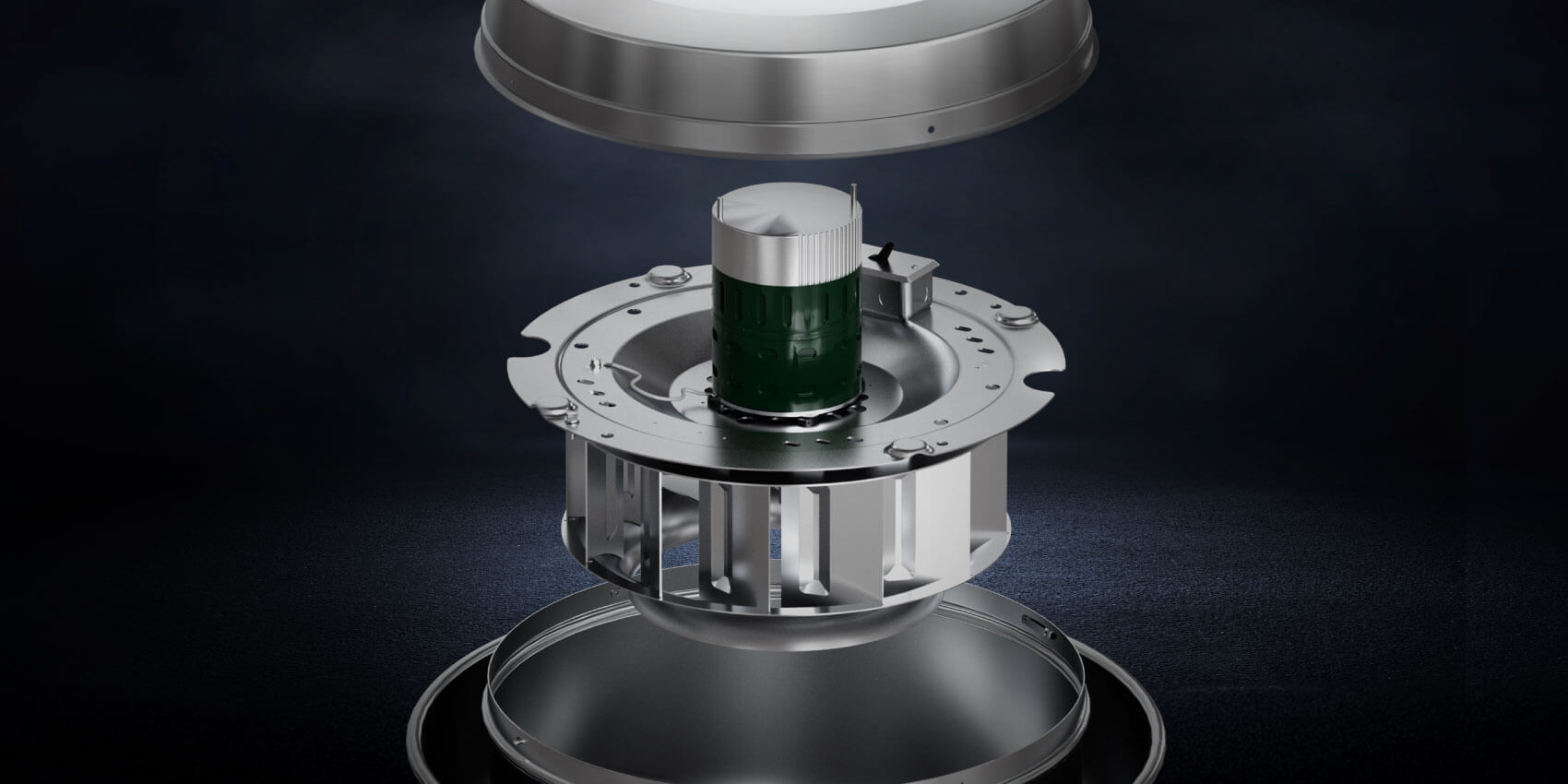
However, these advantages come with distinct serviceability challenges. Because the motor is no longer a separate component that can be unbolted, the direct drive fan often needs to be almost entirely disassembled for motor service. That’s why direct drive upblast PRVs now come with removable power packs, shown in the image at top. With this design, the motor, support pan, and fan wheel are combined into a single unit called the power pack. Removing it no longer requires disassembling the fan body. It’s as simple as taking off the cover, disconnecting wiring, unscrewing four bolts, and lifting the assembly out.
This single feature cuts motor replacement time by up to 73% compared to previous designs. That’s a meaningful improvement for contractors when time on the roof is tight.
Options and Configurabilty
With the variety of rooftop setups contractors and technicians see in the field every day, taking advantage of more options in fan selection means more ease and flexibility for the people installing and maintaining the fan. For instance, one new option is curb cap configurability.
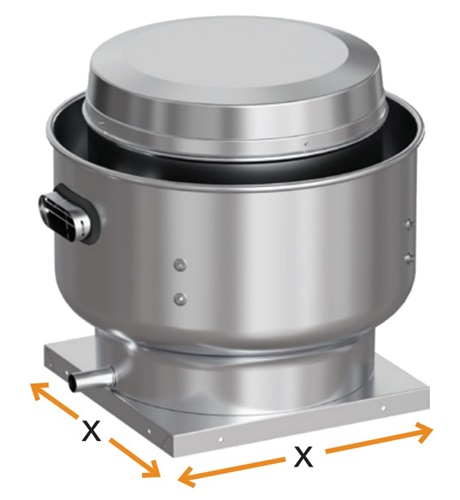
The square base of a PRV, called the curb cap, is mounted to a roof curb. The dimensions of roof curbs are not standardized across the industry. The roof curb is covered at its base by rubber roofing material, and it would be very labor-intensive to rip out and change an installed roof curb. Therefore, the roof curb is typically just left in place when an upblast fan is replaced. The odds of a new fan having the same base dimensions as the old one are low. So an adapter is typically used, adding more cost, installation time, and unnecessary fan height.
Fortunately, fan curb caps are now configurable in one-inch increments, so that a new upblast fan can be retrofitted onto a roof without an adapter. In new construction, this configurable curb cap option allows a fan to fit onto a larger-than-average roof curb for larger ductwork.
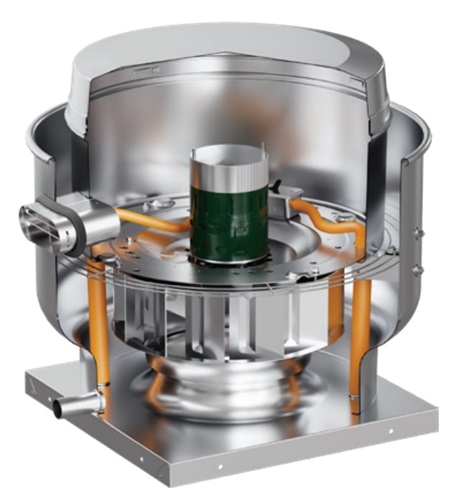
Another useful option is that a fan can be ordered with two conduit chases. The conduit chase is the path by which electrical wiring goes up through the fan base to the motor. Typically, upblast fans only have one conduit chase. When using a fan motor that can be controlled via low-voltage control signals, including a second conduit chase has advantages. Per most building codes, power and control wiring should not be run through the same conduit. Having two conduits allows discrete paths for control and power wiring. It also streamlines the wiring process by making sure each type of wiring has enough space within its conduit.
Making the Little Things Easier
It’s the little things in fan design that can make the difference between a long day on a hot roof and a quick job well done. One of those things is toolless entry. Powered roof ventilators have now been designed so that getting into the motor compartment for service or wiring does not require a screwdriver, just the push of two buttons. No more screws to strip, drop, or lose on the roof.
Also, the lower hoodband height of new upblast fans means that more of the fan gets taken off when you take the cover off. The fan sitting on a roof curb is already elevated, so any interior depth that can be reduced helps the contractor. The fan components needing service are now more easily within reach.
When every minute of downtime costs money, serviceability in fan equipment isn’t just a nice-to-have but a necessity. Ask your nearest Greenheck representative if you have questions about adding an upblast exhaust fan to a commercial building.
.png?sfvrsn=9348a6bf_1)