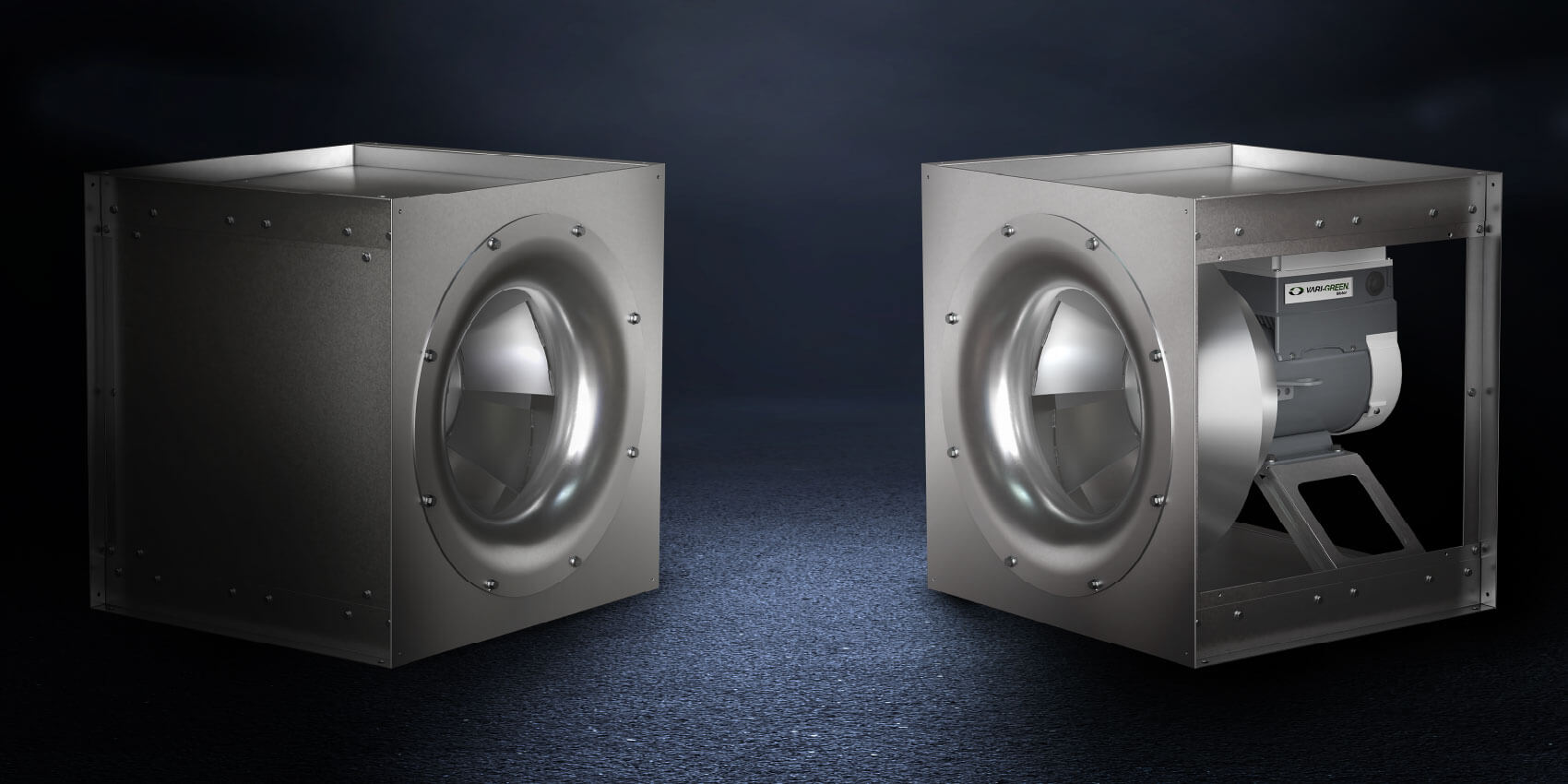
The Fan Energy Index (FEI) is a metric for comparing the energy consumption of a reference fan to the energy used by an actual fan at the same duty point. If the two fans use the same amount of energy, the FEI of the actual fan is 1.00. If the actual fan uses 10% less energy, it has an FEI of 1.10, and if it uses 10% more, it has an FEI of 0.90.
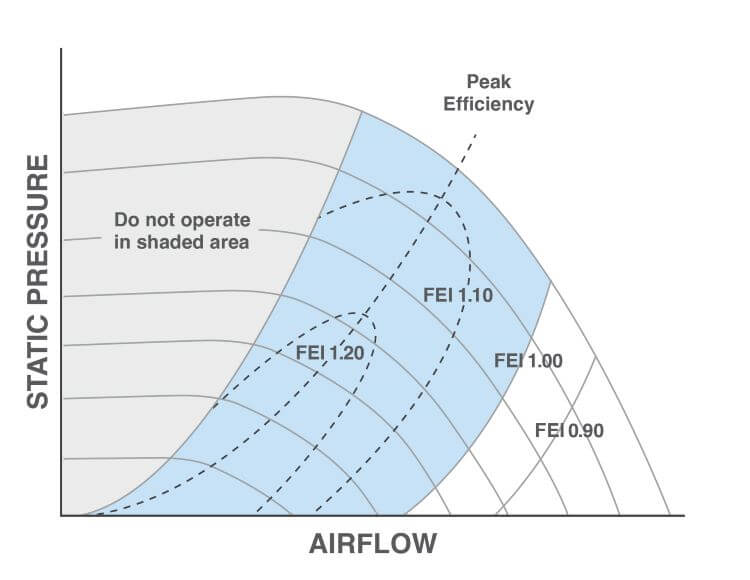
By accounting for losses from variable frequency devices (VFDs), motors, and drives, FEI is a more comprehensive metric than brake horsepower. It helps engineers make a better fan selection for their application by identifying quieter fans that have a more flexible operating range. As shown in the fan curve below, a fan system with a higher FEI rating runs at a more central point on the curve. This provides more forgiveness against unforeseen static pressure conditions in installed air systems and allows for more utility across operating points.
To put FEI to the test, Greenheck compared the FEI performance of five different square centrifugal inline fan systems. All five had a duty point of 3,300 cfm at 1 inch of water gauge, operating at standard air conditions. However, other differences resulted in a wide range of FEI ratings and performance values.
Definitions
- Centrifugal Inline Fan: Ceiling- or floor-mounted fan used for intake, exhaust, return, or make-up air.
- Belt Drive vs. Direct Drive: In a belt-driven fan, the impeller is connected to the motor shaft by a belt and pulley system. In a direct drive fan, the motor and impeller are connected directly.
- AC Motor vs. EC Motor: An AC fan motor is a standard alternating current motor, while an electronically commutated (EC) motor combines AC and DC currents for precise speed control.
- Backward-Inclined Impeller vs. Mixed Flow Impeller: A backward-inclined (BI) impeller moves air perpendicular to the shaft using blades angled away from rotation, while a mixed flow impeller mixes axial and centrifugal flow patterns to move air both along and outward from the shaft.
- Brake Horsepower (BHP): The amount of force needed to stop a fan's motor.
- Fan Electrical Power (FEP): The electrical power needed to operate a fan system.
- LwA: A measure of fan sound.
Comparison
All values below are from Greenheck's engineering product selection suite, eCAPS®.
Fan | Description | BHP | FEP | RPM | LwA | FEI |
Fan 1: BSQ-140 | Noncompliant Belt Drive BI Impeller with AC Motor | 1.72 | 1.54 | 2005 | 87 | 0.79 |
Fan 2: BSQ-160 | Larger Compliant Belt Drive BI Impeller with AC Motor | 1.20 | 1.08 | 1428 | 80 | 1.10 |
Fan 3: SQ-160 | Direct Drive BI Impeller with AC Motor and VFD | 1.14 | 1.06 | 1449 | 81 | 1.12 |
Fan 4: SQ-160-VG | Direct Drive BI Impeller with EC Motor | 1.14 | 1.00 | 1449 | 81 | 1.18 |
Fan 5: SQ-16-M2-VG | Direct Drive Mixed Flow Impeller with EC Motor | 0.86 | 0.77 | 1379 | 75 | 1.53 |
Fan 1 is a belt-driven fan with an AC motor and a BI centrifugal impeller. Its FEI value of 0.79 is noncompliant with the latest versions of ASHRAE 90.1 and IECC. This fan could not be used in states or municipalities that have adopted these standards and codes.
Fan 2 has gone up in size and decreased the impeller rotations per minute (RPM). It has an FEI of 1.10, which is only slightly over minimum requirements. It is quieter and uses less energy than Fan 1, but its components—a belt drive, an AC motor, and a BI impeller—do not take advantage of the most efficient fan technologies available.
Fan 3 has been upgraded to a direct drive with a VFD added to control the speed of its motor. The change in drive type improves the FEI rating by eliminating belt and pulley drive losses as well as bearing losses. The VFD enables lower speeds when less airflow is needed, saving energy.
Fan 4 changes the motor technology to a more compact EC motor. Now, though the fan system has the same brake horsepower as Fan 3, it has a higher FEI value. The use of an EC motor expands the system’s operating range to adapt better to varying static pressure conditions.
Fan 5 upgrades the impeller type from backward-inclined to mixed flow. This increases FEI and broadens the fan’s operating range further. Fan 5 has the lowest sound, the lowest BHP, and the highest FEI of the five selections.
Takeaways
- Brake horsepower doesn’t tell the whole story. If an engineer were looking only at BHP, they might conclude that fans 3 and 4 are the same. But fan 4 has a more versatile EC motor, resulting in a lower FEP score and a higher FEI rating.
- Higher FEI values often correspond to larger fans that rotate more slowly. Between Fan 1 and Fan 2, we upsized the fan from size 140 to size 160. This reduced fan RPM from 2,005 to 1,428 and increased FEI from noncompliant to compliant. But this does not mean the largest fan is always best! On the contrary, if a manufacturer presents a fan option that meets minimum FEI requirements but does not contain other aerodynamic components such as a mixed flow impeller or direct drive design, look closer to make sure it is not simply an oversized fan.
- Fan systems with higher FEI are often quieter. As FEI increases, sound typically decreases, contributing to peace of mind in hotels, schools, and other indoor environments.
- Higher-FEI fans tend to have a more flexible operating range. Fans like Fan 4 and Fan 5, which feature EC motors and mixed flow impellers, can maintain peak performance across a wider range of operation, giving engineers more forgiveness against design deviations in the field.
- FEI can point to the most suitable fan for an application or one that isn’t up to par. The higher the FEI rating, the more likely it is that a fan has features such as a direct drive system or mixed flow impeller that correlate with reduced maintenance and longer component life. Conversely, low-FEI fans may be unnecessarily loud or too small for the application.
As these results show, FEI is more than a minimum value to meet while complying with code. Schedule and hold FEI values at the actual duty point for each fan selection. When choosing fans, take FEI values into account to select fans with flexible performance and low sound as part of a building’s well-functioning HVAC system.
Get the most out of FEI by visiting our Fan Energy Index page for a state adoption map and timeline, a sample fan schedule that includes FEI, and more.
Fan Energy Index Fans