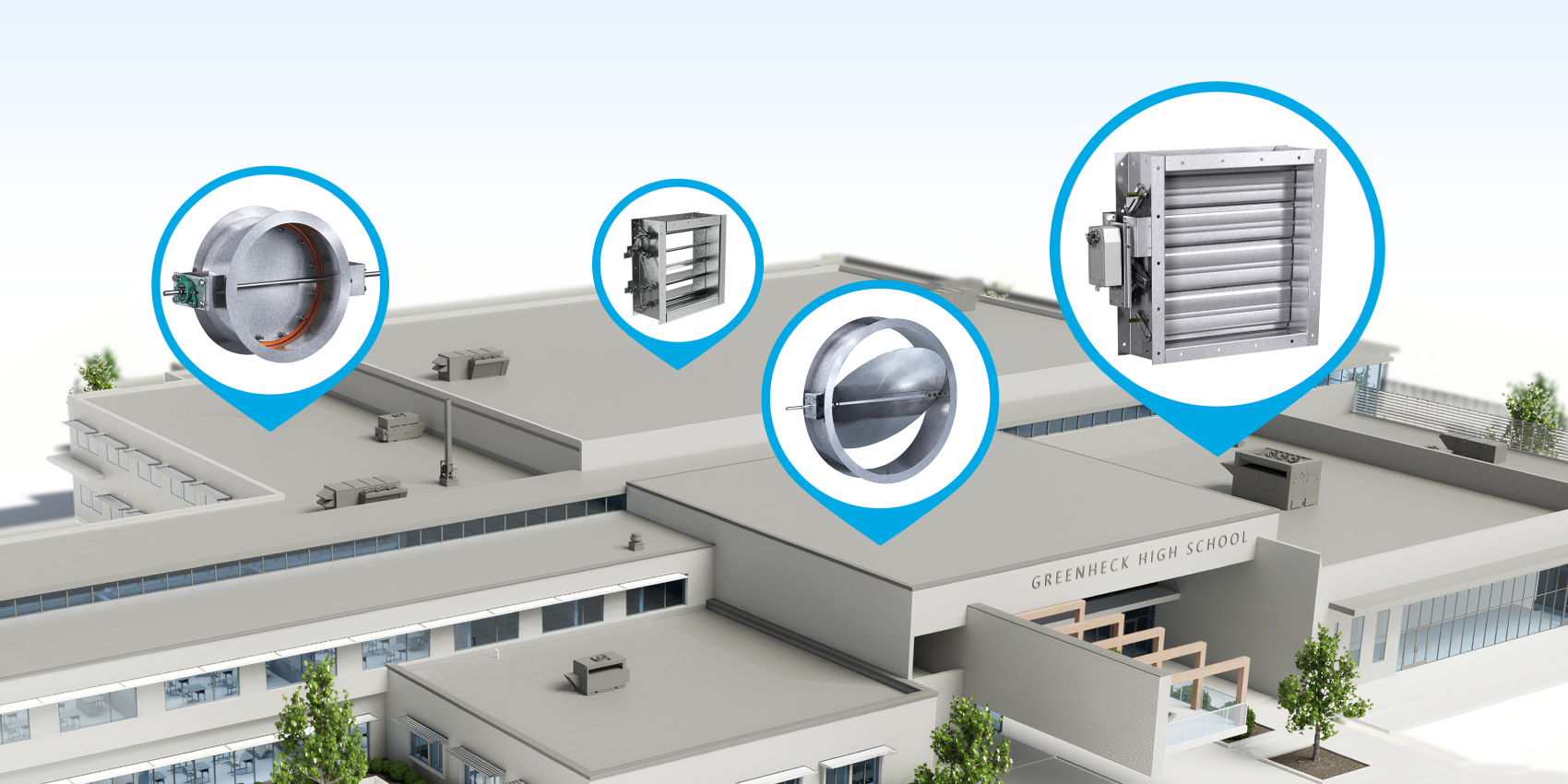
Within a K-12 school, the ventilation system serves many types of spaces that exist for different purposes. These can include quiet classrooms, a high-occupancy gymnasium, a humid locker room, a science lab where fumes must be contained, a kitchen where cooking byproducts need to be exhausted, and shelters designed for emergency use. Each area places its own demands on airflow, pressure control, safety, and equipment reliability.
Greenheck’s interactive K-12 school experience illustrates how rooftop and energy recovery equipment, fans, louvers, and other products work together throughout these varied spaces. Dampers are an integral part of that system. In certain school locations and applications, the right choice may be an industrial damper.
Application, Not Building Type, Drives Damper Selection
One of the most common misconceptions about industrial dampers is that they belong only in power plants, steel mills, and other heavy-process facilities. In reality, many industrial damper applications are in buildings such as hospitals, laboratories, warehouses, and schools. The operating requirements, not the building category, determine whether an industrial damper is appropriate.
High pressures or velocities, tight pressure control, corrosive airstreams, demanding reliability expectations, and long service-life requirements can all point toward a more robust solution. A school may not be a heavy industrial facility, but certain systems within it can place industrial-level demands on airflow control equipment. That does not mean industrial dampers should be specified throughout every school; rather, engineers should look beyond the building label and evaluate what each damper must do.
Storm Shelters and Tornado-Resistant Spaces
School storm shelters have ventilation and equipment-protection requirements different from those in ordinary occupied spaces. International Code Council (ICC) Standard 500 provides guidance for storm shelter construction but does not prescribe a specific damper type for every opening.
- When making a damper selection for a school storm shelter, consider what the damper and surrounding system must accomplish before, during, and after a severe-weather event.
- Engineers can use industrial dampers to protect the facility, support natural ventilation in a shelter or gymnasium, or isolate standby and emergency equipment.
- When protection of equipment and occupants is critical, a robust control damper or tornado damper designed to withstand wind loads up to 250 mph is a common and practical option.
Science Labs
Though K-12 science labs usually do not have the same hazardous containment requirements as university research labs, they may still contain chemical fumes, solvents, and processes that require the reliable exhaust, isolation, or room-pressure control that an industrial-grade damper delivers.
- Consider low-leakage, zero-leakage, or bubble-tight dampers for application like fume hood exhaust isolation or maintaining pressure relationships between the lab and adjacent spaces.
- Stainless steel or coated damper construction can provide the required durability for corrosive exhaust involving acid fumes or solvents.

Career and Technical Education Shops
Career and technical education (CTE) spaces can resemble industrial environments more closely than almost any other part of a school. Woodworking, welding, and automotive labs may generate dust, particulates, and high-velocity exhaust. Equipment may also operate on schedules and duty cycles unlike those in typical classrooms.
- Industrial control dampers and backdraft dampers can help the system manage demanding airflow conditions, resist wear, and reliably prevent reverse airflow.
- Because shop exhaust systems must maintain sufficient airflow to capture dust and fumes at or near the source, damper selection should account for pressure drop as well as repeated cycling with equipment use.
Emergency Power and Generator Ventilation
Schools with storm shelters or other emergency functions often include standby generators. Because system failure during an emergency can have significant consequences, dependable airflow control and equipment protection are important. These applications often involve higher airflow, elevated temperatures, and critical operation during severe weather events, making industrial dampers a logical fit.
- An industrial damper can provide the construction and performance needed for intake, exhaust, or isolation duties.
- Dampers can be interlocked with the generator so intake and discharge openings are open whenever the unit runs, helping maintain the airflow needed for cooling while protecting the equipment room from outdoor conditions when the generator is off.
Natatoriums (Pools/Aquatic Centers)
Indoor pools with high humidity and chemically aggressive air can be a harsh environment for a damper. Over time this can lead to corroded blades, seized bearings, and failed linkage, resulting in reduced performance and premature damper replacement.
- Consider an industrial-grade damper with all components made of stainless steel to maximize service life and resist corrosion.
- Dampers in this application can often be in hard-to-access areas where maintenance or replacement can require significant labor costs, making durability and longevity a key consideration.

Sensory Rooms and Special Education Spaces
Sensory rooms within special education departments are designed to provide a stable, quiet, and controlled environment.
- Some schools use ultra-low-leakage or bubble-tight isolation dampers in supply air ducts serving sensory rooms.
- A tightly sealing damper can help minimize unwanted airflow changes and background noise from the ventilation system.
When Should You Consider an Industrial Damper?
While no single checklist replaces a complete application review, the following project conditions indicate that an industrial damper may be appropriate. The school’s budget remains important, but so does selecting equipment suited to the actual airstream and performance requirements.
- Storm shelters or tornado-resistant spaces
- Science labs and fume hood exhaust systems
- Vocational shops or manufacturing labs
- Generator rooms and emergency equipment ventilation
- Natatoriums (indoor pools) and other corrosive environments
- High-velocity or high-pressure duct systems
- Applications requiring critical isolation or ultra-low leakage
Dampers may be supporting cast members in a school’s ventilation system, but their role is essential. In the right application, a heavy-duty solution can offer the performance, reliability, and longevity needed to protect equipment, support specialized learning spaces, and help critical systems operate as intended.
Your local Greenheck representative can discuss the application with you and determine the best damper solution for your project.
Dampers