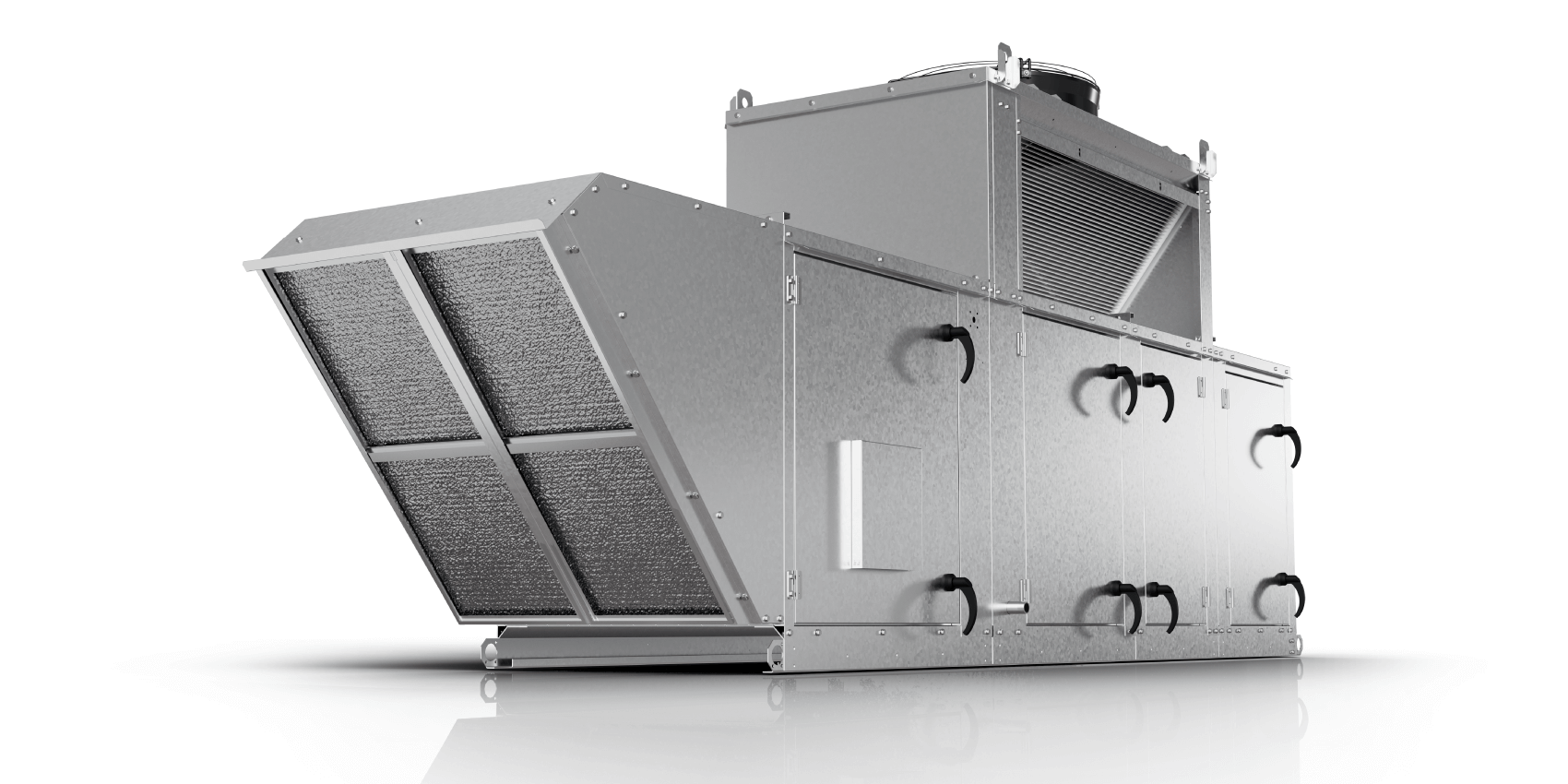
Exhaust air may be removed from a building for many reasons: smoke, heat, odors, contaminants, or the byproducts of an industrial process. To balance pressure in the space, that air must be replaced by more air. If replacement air is not provided in a controlled way, the building will pull outdoor air in wherever it can. This decreases comfort, unnecessarily increases energy use, and makes the ventilation system’s performance less predictable.
That’s where make-up air comes in. Make-up air equipment delivers controlled outdoor air to replace air that is exhausted, typically from a process such as cooking or manufacturing. Beyond that simple definition are many potential uses, both in different applications—kitchens, warehouses, factories—and different configurations to interact with other HVAC equipment.
Let’s dig into some common questions about adding a make-up air unit to a building’s ventilation system.
Why is make-up air needed in buildings?
Make-up air is most often used for balancing pressure to meet airflow requirements. When more air is exhausted than supplied, a space experiences negative pressure. Doors become harder to open and exhaust systems lose effectiveness. Infiltration, the leakage of unconditioned outdoor air into the space, occurs through gaps around windows and cracks around doors.
A make-up air system can balance airflow with exhaust to support any strategy.
- Negative pressure is desirable in some applications, such as hazardous storage areas where contaminants are meant to be contained and properly exhausted.
- More often, neutral or slightly positive pressure is used to provide comfort and energy efficiency.
Another important use for make-up air systems is tempering outdoor air, both for comfort and to prevent freezing inside the building. This is usually done as part of maintaining the building pressure differential. However, in certain applications such as warehouses, a make-up air unit can have tempering as its primary function.
Keep reading to learn how make-up air is used in warehouses and how the air is tempered.
How does make-up air interact with other HVAC equipment?
Make-up air, sometimes referred to as MUA, is integrated with many other parts of the building’s ventilation system.
- Exhaust fans, hoods, and other equipment remove air through exhaust ductwork.
- Supply airflow from the MUA unit increases or decreases to maintain the pressure set point.
- In advanced systems, a microprocessor controller integrated with the building management system (BMS) ramps make-up air supply up or down based on the pressure difference between the building and outdoors.
Other rooftop units, such as an RTU or Dedicated Outdoor Air System (DOAS), can be used to add conditioned outdoor air to a space. These units have additional capabilities, including exhaust. Which type of unit to use depends on the application.
- For most make-up air applications, the airflow requirement comes first. Heating and cooling temper the outdoor air in a way that meets code, comfort, and operational needs.
- Comfort-focused systems like DOAS and RTUs are typically driven by temperature and humidity targets, adjusting airflow to meet those conditions.
Make-up air can work alongside other unit types. A kitchen application might use make-up air for the exhaust from its hood and a DOAS unit to make its kitchen and dining area comfortable. This removes the need to upsize the DOAS unit to provide the airflow needed for making up the exhaust.
From top to bottom, the below illustration of an industrial application shows how make-up air can be integrated with other HVAC components.
- The upblast exhaust fans on the roof remove contaminated air from the building.
- The make-up air unit uses a supply fan to bring in outdoor air and supply it to the interior duct system. While inside the unit, the air is filtered and tempered.
- Diffusers direct the conditioned air into the space.
- Local exhaust hoods capture the unwanted exhaust air to continue the airflow cycle.
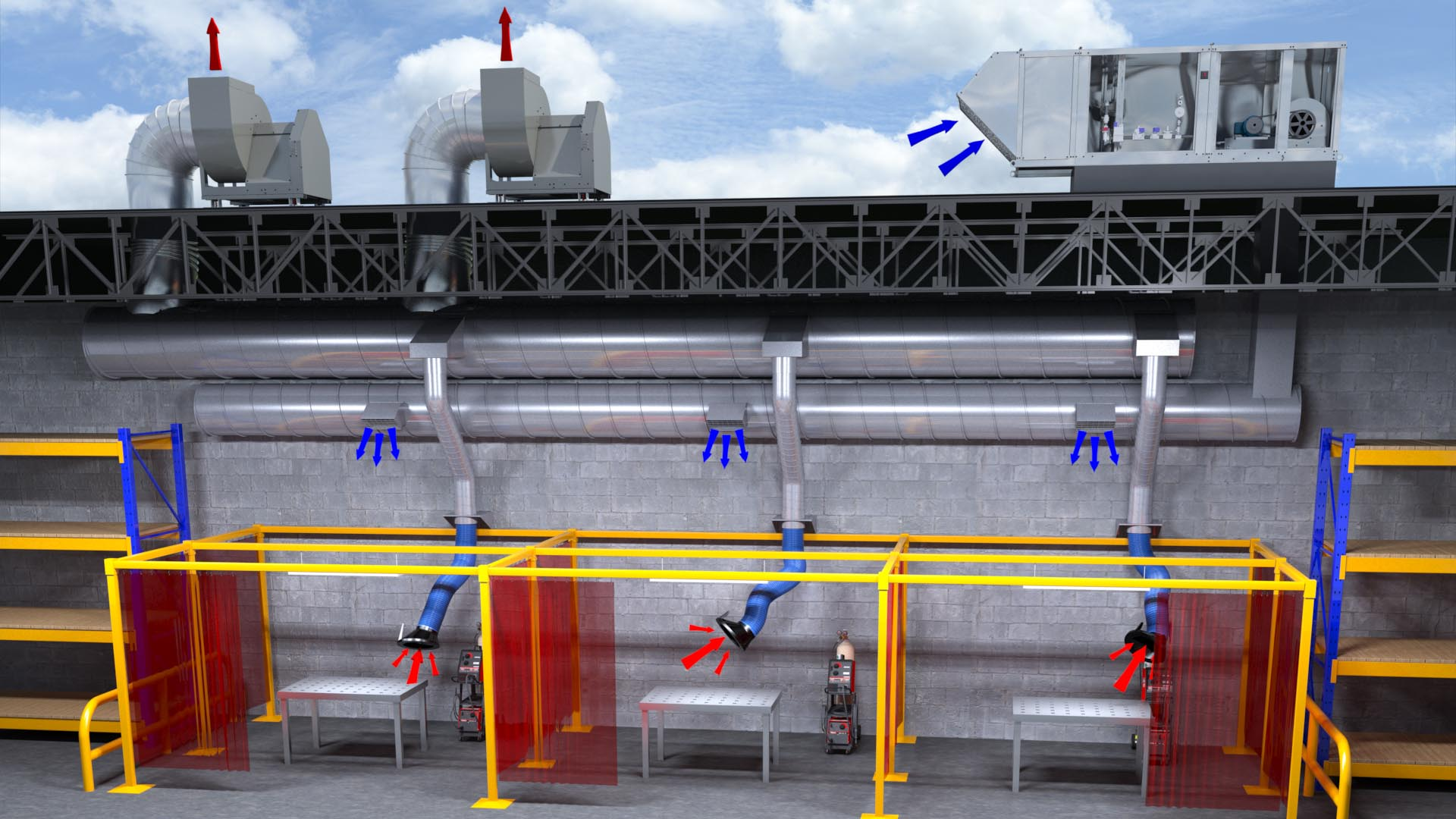
Industrial Make-Up Air Application
Which applications use make-up air?
Industrial
In industrial settings like the one above, air is exhausted directly from a process such as welding, painting, or sanding. Welding stations, paint booths, and other manufacturing spaces remove air to control contaminants or heat. In these cases, airflow volume is the main driver.
When the process turns on, exhaust airflow increases and make-up air must respond accordingly. Tempering the air is necessary for comfort and freeze protection, but the primary purpose is replacing the exhausted volume.
Because processes may operate on schedules or vary throughout the day, airflow rates can vary as well. Make-up air units can be configured with variable air volume (VAV) capabilities to respond accordingly if exhaust rates change.
Commercial Kitchens
Commercial kitchens are the application most people associate with make-up air, and for good reason. Cooking processes generate heat, smoke, grease, and odors that must be exhausted through kitchen hoods. Losing that much air can quickly result in negative pressure, reducing hood capture efficiency.
As a result, building codes often require make-up air in commercial kitchens. International Mechanical Code (IMC) 505 dictates that when a kitchen hood exhausts 400 cfm or more, that air must be replaced.
IMC 508.1 limits the temperature differential between the supply air and space temperature to 10ºF, either plus or minus. So while the introduction of make-up air into the kitchen is primarily about replacing exhaust airflow, how effectively and efficiently the unit tempers the air is another important consideration.
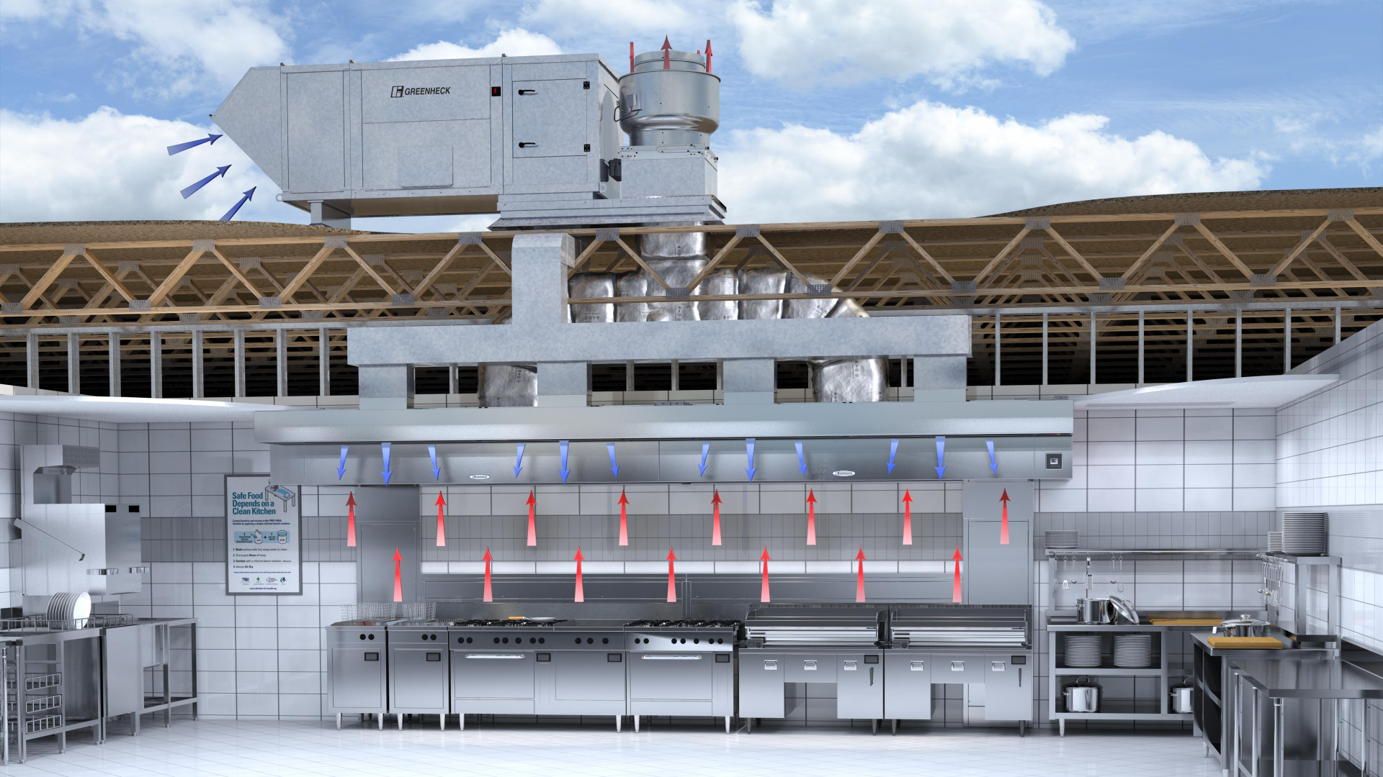
Kitchen Make-Up Air Application
Warehouses and Distribution Centers
In warehouses and distribution centers, large loading dock doors can cause rapid pressure changes and heating challenges in the winter. Tall ceilings also cause air stratification, as warm air rises to the ceiling and cool air sinks. Make-up air is often used in these spaces as a solution to both control pressure and provide an economical, efficient heating solution.
The make-up air unit cycles on to provide bursts of heated outdoor air when needed, maintaining a relatively low setpoint of 55–60°F. It also balances pressure by providing outdoor air to combat infiltration, ramping the outdoor air percentage up to room-neutral or slightly positive pressure.
Warehouse applications use either recirculation to provide energy savings and maintain pressure setpoints within the space, or constant volume to allow for shorter unit run times when space heat is the main goal and pressure control is not needed.
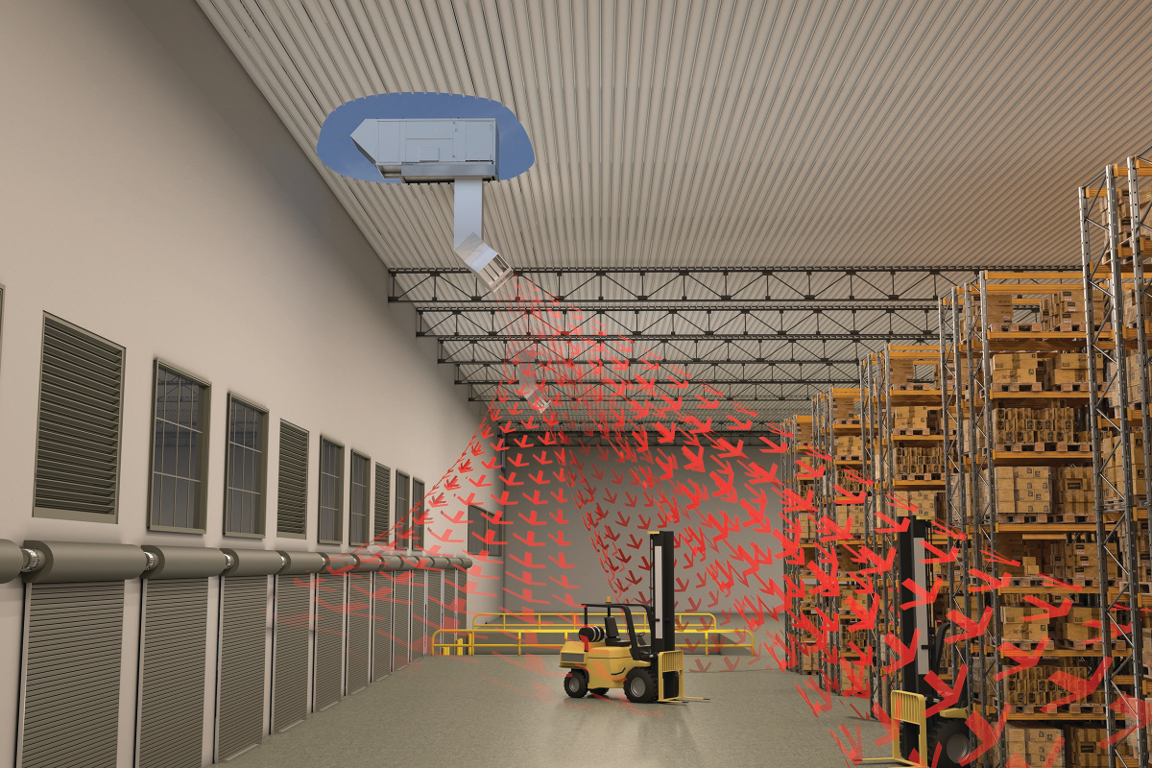
Warehouse Make-Up Air Application
How do make-up air systems heat or cool outdoor air?
Befitting an HVAC technology with so many different applications, the heating and cooling options in make-up air are numerous. Starting with cooling, the options include:
- Chilled water cooling uses a coil supplied by a central chiller and fits well into facilities that already have chilled water infrastructure.
- Evaporative cooling uses the natural cooling effect of water evaporation. It works best in dry climates and has limited cooling capacity when moisture levels are high.
- Packaged refrigeration (PDX) is a mechanical cooling system contained within the make-up air unit, providing precise temperature control across a wide range of outdoor temperatures and humidity levels.
Make-up air units can be configured with various heating options as well, including hot water, steam, and electric heat. Two additional options—direct gas and indirect gas—bear a closer look.
Direct gas-fired make-up air heats 100% outdoor air over a gas flame to temper it. It is the most efficient make-up air heating technology and also has the highest turndown range, meaning the ratio between the burner’s maximum firing capacity and its minimum stable firing capacity. The higher the turndown, the more effectively the unit can respond to part-load conditions and control comfort.
A make-up air unit can be configured with direct gas even if it contains PDX. PDX systems use A2L refrigerants, which have a low global warming potential and low flammability. Any flammability potential must be mitigated with safety measures, so direct gas-fired units are designed to sense and prevent refrigerant leaking into the burner.
Indirect gas heating warms make-up air using a heat exchanger, so the products of combustion are vented outdoors and do not mix with the supply air. It is ideal when the unit is being used to ventilate for occupancy rather than for an industrial or cooking process. Fire codes mandate that direct gas equipment cannot serve areas that contain sleeping quarters.
The ASHRAE 62.1 standard also specifies CFM/person requirements to keep CO2 levels low. Therefore, less outdoor air is needed to offset CO2 if indirect gas heating is used.
However, indirect gas has lower efficiency and more limited turndown capability than direct gas, so direct gas is the better choice if ventilating for a factory or commercial kitchen. The outside air safely dilutes the byproducts of direct gas combustion.
How can I find out more about make-up air?
Greenheck has additional blog posts and resources to build your make-up air knowledge.
- Dive deeper into when make-up air is required for kitchens and how it compares to other solutions.
- Get up to speed on how microprocessor controllers work to simplify make-up air operation.
- Learn about the tested safety features that make direct gas-fired units with PDX cooling compatible with A2L refrigerants.