

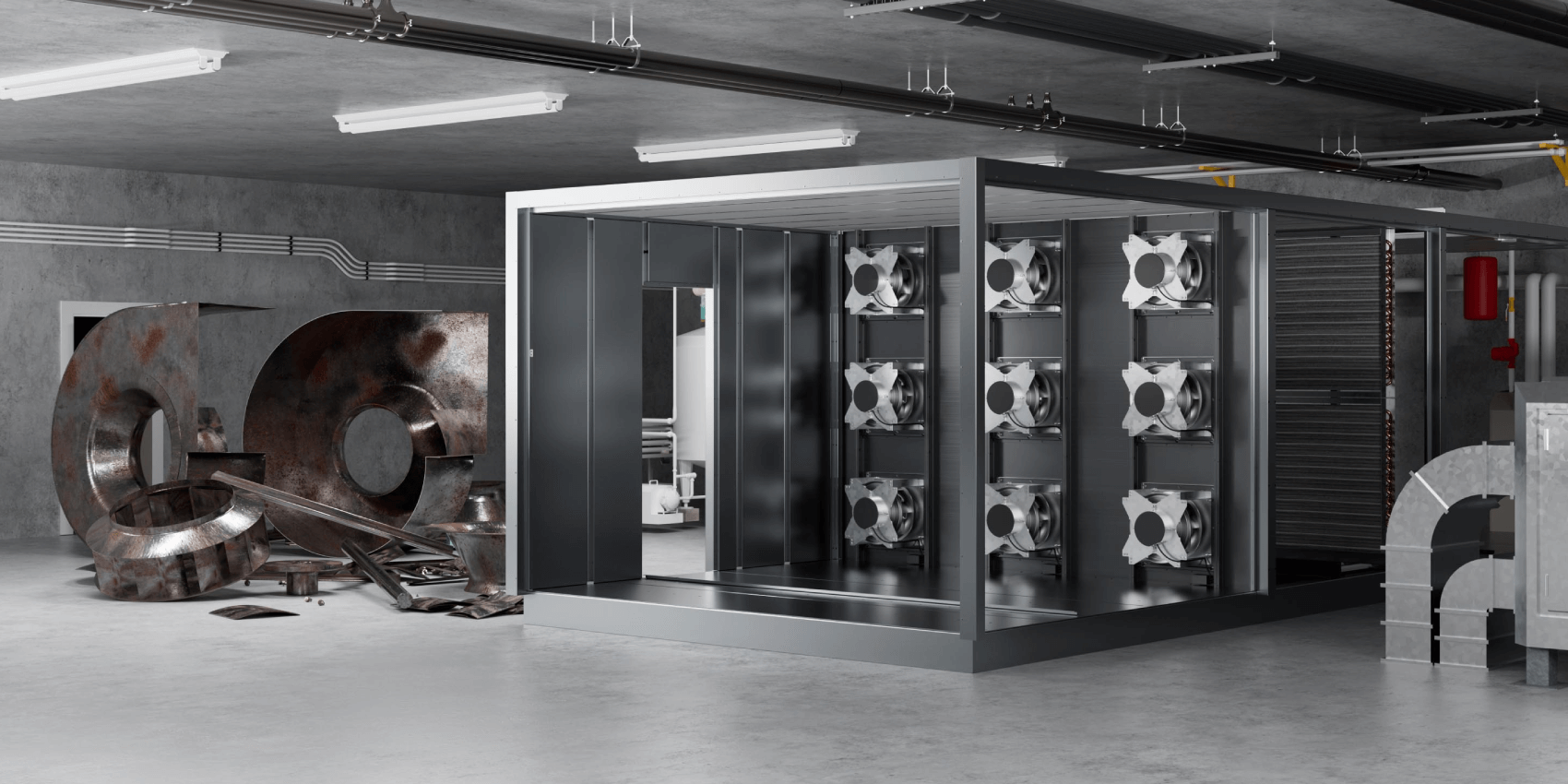
Many HVAC systems are still using a single large fan to move air through a duct or air handler. If this fan is belt-driven, it can present energy efficiency issues over the long run due to losses from its mechanical transmission and friction. It also needs frequent realignment and inspections, adding to maintenance costs. If a belt or bearing fails at an unexpected time and there is not a redundant fan in the system to make up the airflow, it can lead to discomfort for building occupants, or in a critical application such as a hospital, more significant consequences.
That’s why more building owners are now choosing to upgrade their belt-driven fan to an electronically commutated (EC) fan array. This array has multiple smaller fans, each equipped with its own EC motor, which is a brushless DC motor with integrated electronic control. Upgrading to this setup is much easier than installing a new belt-driven fan and can provide payback within a few years due to the monthly energy savings that stack up. Read about these and other advantages in our post.
Fan Arrays Are Easier to Install
When a duct or air handler system relies on a single fan, that fan was often installed when the building was constructed. If it needs to be replaced, it is difficult to get a like-for-like fan on the market and even more challenging to get a single replacement fan large enough for the required design airflow into the same spot. Disassembly with a cutting torch, then reassembly, would be the likely “solution.”
The fans that go into a modular EC fan array are comparatively lightweight and easy to carry. They can fit onto elevators, through standard doorways, and into tight spaces in mechanical rooms. The fans are factory-assembled with plug-and-play wiring connections. The simpler process of installing an array reduces the project cost of a retrofit.
EC Motors Use Less Energy
Traditional AC induction motors operate at a fixed speed determined by the power supply frequency. By contrast, EC motors electronically adjust their speed and torque to match airflow or pressure demand. This is done with minimal energy loss due to the motor’s permanent magnet rotor, which eliminates rotor current losses, and onboard electronics that sustain near-optimal efficiency across speeds.
By continuously matching fan speed to real-time demands, EC motors avoid the waste of running at full power when it isn’t needed. As a result, building owners typically see a significant drop in energy usage and utility bills, including reduced peak demand charges. Over time, these savings result in a shrinking carbon footprint and payback on the investment.
Less Maintenance, More Uptime
AC fan systems rely on belts and pulleys and may use an external variable frequency drive (VFD) to control the motor’s speed. These components need to be maintained and are common failure points. The routine replacement of the belts presents an access difficulty. Motors and bearings for older belt-driven fans are large, heavy, expensive, and challenging to find.
EC fan arrays have no belts, pulleys, bearings, or VFDs. This translates into maintenance savings, longer-lasting parts, and more fan uptime.
Fan Redundancy Protects Against the Unexpected
Single-fan systems are vulnerable to the breakdown of that fan. If it fails, the system will not meet design airflow, or may not have any airflow, until fan repair or replacement can be done. This can make building occupants uncomfortable in any application and be a serious issue in a laboratory, data center, or hospital.
Because fan arrays use multiple fans, they are more reliable. In the common N-1 configuration, if a fan fails, the remaining fans ramp up to maintain full airflow. This minimizes or eliminates downtime, giving building owners peace of mind knowing their ventilation system won’t stop when one component does.
Balanced Air Distribution Maximizes Comfort
A single large fan tends to deliver airflow at a velocity that peaks at the center and drops off toward the edges. This creates areas of reduced airflow, leading to uneven filter loading where the center of the filter receives the most air and clogs faster while the edges remain underused. As a result, the fan system wears down faster, uses more energy, and provides uneven indoor comfort.
EC fan arrays, by comparison, promote consistent airflow because multiple small, evenly spaced fans are positioned across the cross-section of the air handler so that air is drawn uniformly across the air handler’s face area. This ensures that filters load evenly, extending service life and improving indoor air quality (IAQ).
Modular Flexibility for Future-Ready Design
Each fan in an EC fan array is a module that includes a motor, an impeller, and electronics. This allows one fan to be removed or replaced without shutting down the entire system. Maintenance staff can pull out a fan from the array without disassembling large duct sections or disturbing other components.
The array size can also be customized to fit each application, such as an office building. If the needs of the building and its occupants change, the array can scale up or individual fans within it can be upgraded. The entire array is controlled with a single touchscreen panel and can be integrated with the Building Management System (BMS) for more advanced control and further efficiency gains.
Conclusion
By replacing belt-driven systems with smart, modular EC fans, building owners gain energy savings, better IAQ, and reassurance that their systems will keep running even when one fan is offline. When retrofitted to existing construction, EC fan arrays deliver consistent comfort and performance that aligns with the energy goals of modern buildings.
Your local Greenheck representative can answer questions about adapting a fan array to the specific needs of your application.
Fans.png?sfvrsn=9348a6bf_1)