Air conditioning cools air, but fans cool people. Fans increase air speed, which increases the rate of evaporation from the skin and removes the layer of warm air near people and animals in a process called convection cooling. Industrial environments like warehouses and livestock barns, and large commercial spaces like gyms and retail stores, use ceiling fans instead of, or along with, air conditioning to provide thermal comfort at a much lower operating cost.
ASHRAE Standard 55 has the goal of keeping most occupants of a building thermally comfortable, accounting for variables such as air temperature, air speed, humidity, and clothing. When selecting ceiling fans as part of a building design that complies with ASHRAE 55, engineers have the increasingly popular option of using High Volume Low Speed (HVLS) fans, which achieve a high airflow volume at a low rotational speed due to their large diameter and optimized design. Traditional smaller-diameter ceiling fans are another option.
Do HVLS fans really have advantages over their smaller, faster-moving counterparts, and if so, where? Consider the following factors when deciding which fan type is right for your space.
1. Airflow Volume
Using fans to cool a large, tall enclosure such as a dairy barn or warehouse on a hot summer day requires significant airflow volume. A typical HVLS fan can achieve airflow of 100,000 cfm or greater, aided by featuring 3–8 airfoil blades with a diameter of 8–24 feet. In one study, a 24-ft fan at 50 rpm used in a dairy barn had reported flowrates of 117,000 to 150,000 cfm.1
Advancements in large-diameter fan design now allow a single 24-foot unit to deliver up to 281,700 cfm.
By contrast, a typical ceiling fan with 3 blades and a diameter up to 5 feet produces, at most, 8,000 cfm of airflow. As a result, more ceiling fans must be factored into the space layout, and they must operate at a much higher RPM, to achieve comparable airflow effects.
When evaluating manufacturer-reported performance data, preference should be given to AMCA-certified fans , as AMCA certification provides independent, third-party validation and a consistent basis for comparison across products. AMCA-certified products can be searched in their certified product database.
2. Airflow Reach
In tall enclosures, traditional ceiling fans often struggle to deliver consistent airflow all the way to the floor, leaving lower zones stagnant and uncomfortable. HVLS fans solve this challenge by generating a powerful, column-like air jet that travels downward with purpose, reaching the floor before dispersing smoothly across the horizontal plane. The result is a uniform, floor-to-ceiling air distribution that eliminates hot spots and improves comfort, making HVLS the smarter choice for large, high-ceiling spaces.6
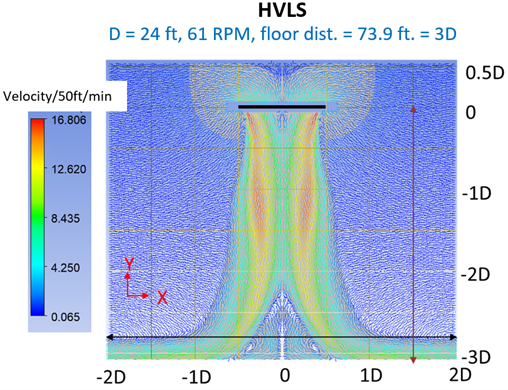
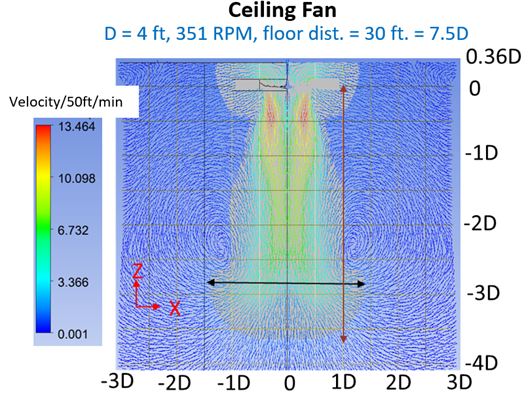
CFM is cumulative, so in theory a building planner could add as many small-diameter ceiling fans as they wanted in order to match the airflow volume of an HVLS fan. However, since the smaller fans are unable to throw air as far as the HVLS fan, their jets will have trouble reaching the floor, where the room’s occupants are, once ceiling heights get higher than 16 ft.6
The difference can be seen in these two velocity fields. The HVLS fan jet is thrown at high velocity for a farther distance and spreads along the floor. The smaller-diameter ceiling fan jet’s throw barely reaches the floor level and spreads only as low-velocity currents in the air.
3. Cost and Energy Consumption
HVLS fans typically have a higher installation cost than smaller ceiling fans on a one-to-one unit basis. However, a single HVLS unit can match or exceed the airflow coverage of 5–15 smaller fans, depending on space geometry and performance targets. Therefore, total installed costs for an HVLS system may be less expensive than for a system using traditional ceiling fans.
Systems relying on a larger quantity of small fans also may have higher maintenance and energy requirements than an HVLS system with fewer, slower-rotating fans. Multiple studies have shown that HVLS systems require less power per unit floor area than banks of high-speed, small ceiling fans.2 In the dairy barn study referred to earlier, the design engineer used fans with 20–24 ft diameters spaced 60–70 ft apart.1 Each fan had an operating cost of only about $1 per day.
4. Airflow Uniformity and Destratification
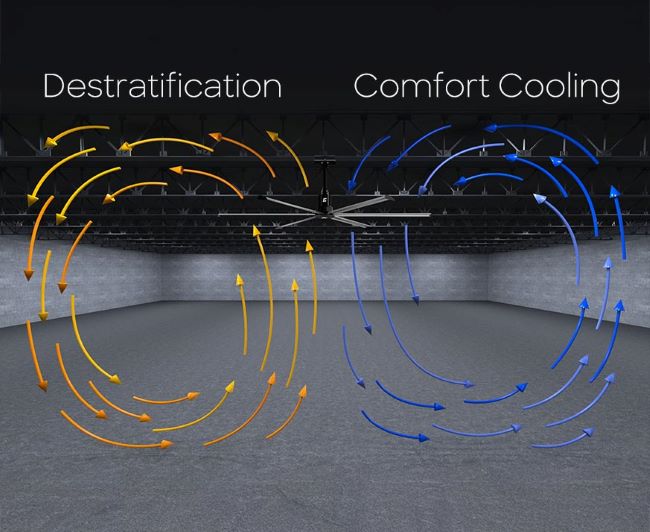
In large, tall enclosures, not only is it important to keep energy consumption as low as possible, but to produce destratification and uniform airflow. Destratification is the process of mixing air to eliminate temperature layers, making the temperature more consistent from floor to ceiling.
The jets of small ceiling fans are strong directly beneath the fan but weaken as they spread over a larger area. HVLS fans, on the other hand, generate a broad, low-velocity downward air column that spreads radially and rises along the boundaries of the enclosure.3 This helps keep air circulation uniform across the entire space, eliminating dead zones and stale air.
In fact, testing in an aircraft hangar during cold outdoor conditions showed that within 10 minutes of operation, HVLS fans reduced floor-to-ceiling temperature gradients from 6.0º F to 0.7º F. 4 The fans needed to operate continuously in order to prevent rapid re-stratification. They were also an energy-efficient solution: by incorporating HVLS fans, the hangar reduced heating energy use by nearly 29%.
5. Space Layout
Walls, partitions, shelving, and equipment can obstruct or redirect airflow, creating uneven distribution. Smaller ceiling fans produce localized, high-speed jets that are easily disrupted by obstacles. For instance, studies have shown that furniture can redirect or distort ceiling fan airflow patterns.5
While layout also affects the airflow patterns of HVLS fans, they produce a broad, horizontal jet that keeps moving around the space, even around obstacles. This is why they are commonly used in applications such as gyms, which have partitions and fitness equipment, to help eliminate moisture and odors in the air.
Matching Fan Type to Space and Performance Needs
Conventional ceiling fans are most effective in smaller, confined spaces requiring localized airflow, such as rooms with low ceilings or targeted cooling near machinery. In areas with a high ceiling or wide span, HVLS fans are better at sustaining large-scale air circulation for uniform comfort throughout the space. HVLS fans provide efficient performance in applications as wide-ranging as indoor agriculture, automotive service (to control fumes and regulate air temperature), manufacturing, and warehouses, where they help keep employees comfortable and protect inventory.
Compare Performance with These Tools
Several digital tools allow engineers to compare fan performance and evaluate thermal comfort under different conditions. The Center for the Built Environment’s CBE Thermal Comfort Tool enables calculations and visualizations that translate ASHRAE 55-related conditions into predicted human comfort outcomes. It also tells the user whether those outcomes comply with the standard.
Greenheck’s online selection tool for engineers, eCAPS®, allows for both size-based and performance-based fan selections. Users can input ASHRAE 55 factors such as metabolic rate and clothing level and see data that helps find a fan within their design parameters and budget.
Find out more about HVLS fans and their applications on Greenheck’s HVLS page. Your nearest Greenheck representative can also answer questions about specifying HVLS fans on a building project as an alternative to a larger number of smaller ceiling fans.
Sources
- Kammel, D.W., Raabe, R.J., and Kappelman, J.J., 2020, “Design of High Volume Low Speed Fan Supplemental Cooling System in Dairy Free Stall Barns,” Applied Engineering in Agriculture, Vol. 36, No. 6 pp. 915–927.
- Aynsley, R. and Thain, W., 2002, “Airflow for energy-efficient comfort,” Proceedings of the 7th World Renewable Energy Conference, Cologne, Germany, June 29–July 5
- Miller, M.R., Nagengast, A., Goore, N., Dasey, S., Uddenberg, S., Harrison, A., and Labidi, M., 2017, “Ceiling Fan Study: Literature and Market Report,” APRISES13, Hawaii Natural Energy Institute, University of Hawaii at Manoa, Honolulu, HI.
- Taber, C., and Steele, B.A., 2020, “Impact of HVLS Fans on Airplane Hangar Air Destratification,” ASHRAE Journal, Vol. 62 (4), pp. 30–34
- Gao, Y., Zhang, H., Arens, E., Present, E., Ning, B., Zhai, Y., et al., 2017, “Ceiling fan air speeds around desks and office partitions,” Building and Environment, Vol. 124, pp. 412–440.
- Chowdhury, J., Kollipara, V., Sargent, T., and Sparks, D., 2026,“Wall Effects on Airflow Performance of HVLS and Ceiling Fans,” Proceedings of ASME Turbo Expo 2026: Turbomachinery Technical Conference and Exposition, GT2026-178175, Milan, Italy, June 15–19.